8 min read
Amortization: Why You Pay Mostly Interest for the First Decade
Your first ten years of mortgage payments aren't really paying down the house — they're paying interest. Here is the math and what to do about it.

If you have a $300,000 mortgage at 7% for 30 years, your monthly payment is roughly $1,996. Of that first payment, $1,750 is interest and $246 is principal. After ten years of perfect payments you'll have paid $239,500 — but you'll still owe $257,400. You've moved the needle by $42,600 in a decade.
That math feels broken. It isn't. It's how every standard fixed-rate mortgage works, and once you understand the structure you can make better decisions about prepayment, refinancing, and how long to actually keep a loan.
The formula behind every fixed-rate mortgage
A mortgage payment is calculated so that one constant monthly amount, paid for the full term, retires the balance exactly. The formula is P × (r / (1 − (1 + r)^−n)), where P is the loan amount, r is the monthly interest rate, and n is the number of months. The result is the payment that makes the loan amortize.
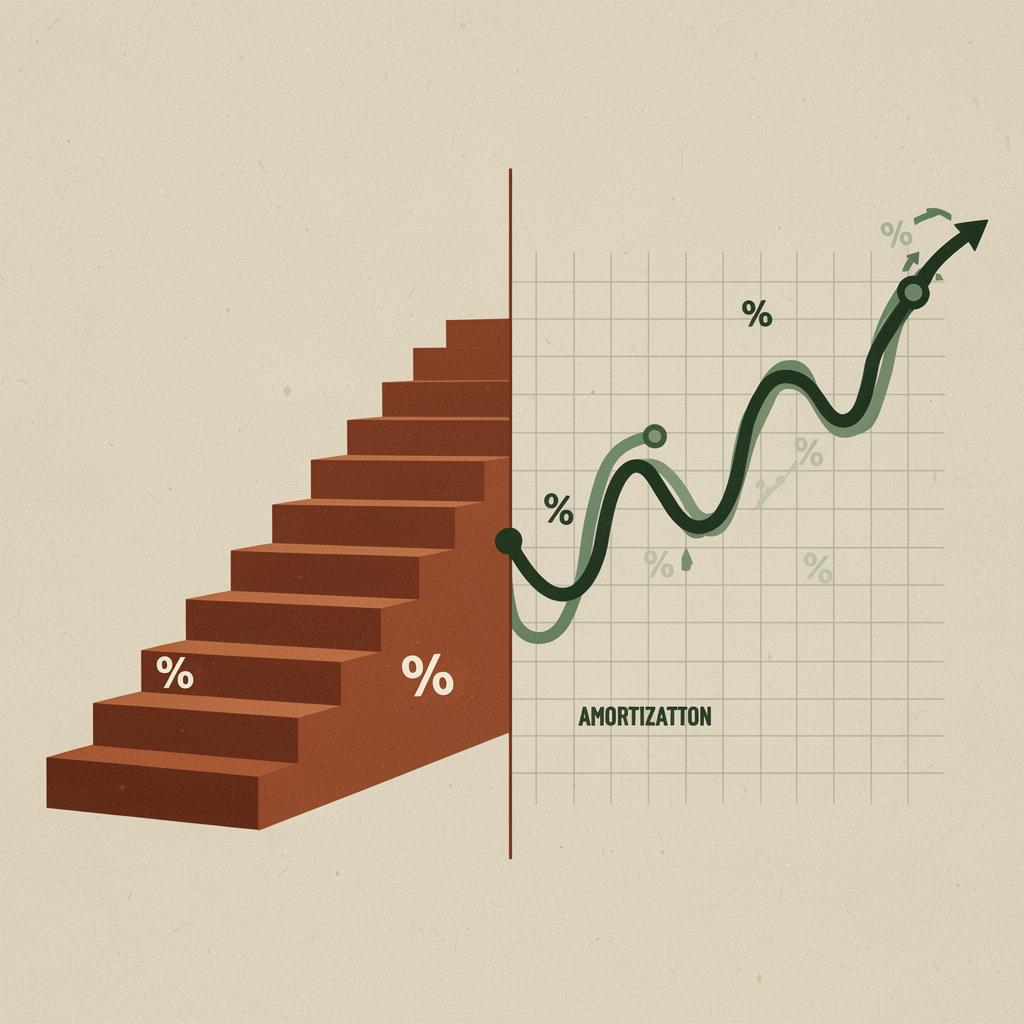
Every month, the interest portion is the current balance times the monthly rate. The principal portion is whatever's left of your fixed payment after the interest is taken out. Because the balance starts high, early interest is huge and early principal is tiny. As the balance drops, interest drops with it and principal grows — but slowly.
The crossover point
Every loan has a crossover month: the month where the principal portion finally exceeds the interest portion. On a 30-year 7% loan it happens around month 220 — over 18 years in. On a 15-year 7% loan, the crossover is at month 38 — about three years in.
This is the structural reason a 15-year loan builds equity so much faster. It's not that the interest rate is lower (it usually is, but only by a few tenths of a percent). It's that the entire amortization curve shifts so most of every payment is principal almost immediately.
Total interest paid over the life of the loan
On a $300,000 loan at 7%: a 30-year loan totals $418,500 in interest. A 15-year loan totals $185,400. The 15-year loan costs $233,000 less in interest, but the monthly payment is $700 higher — $2,696 vs. $1,996. Whether that tradeoff is worth it depends on your income stability, what else you'd do with the $700, and the rates you can earn on invested cash.
The mistake most homeowners make is comparing only the monthly payment, never the lifetime interest. Both numbers matter. The amortization schedule in our calculator shows year-by-year so you can see how the curves diverge.
How extra principal payments actually work
When you send an extra principal payment, it reduces the loan balance immediately. The next month's interest is calculated on the new, lower balance — so every dollar of extra principal saves you future interest at your loan's rate. On a 7% mortgage, an extra dollar of principal today eliminates about $1.30 of future interest payments over a 10-year horizon.
Importantly, extra principal does not lower your scheduled monthly payment. The lender keeps charging the original amount. What changes is that you reach the final payment earlier — the loan amortizes faster. To get the payment lowered, you'd need to refinance or, on some loans, request a recast.
Refinancing and the amortization reset
When you refinance into a new 30-year loan, you restart the amortization curve. If you're seven years into the original loan and refinance into another 30-year, you've extended your total repayment period to 37 years. The new monthly payment may be lower, but you're sliding back to the interest-heavy part of the curve.
Two ways to refinance without resetting: refinance into a shorter term (say, a 20-year or 15-year that ends at roughly the same calendar date), or take the new lower payment but continue paying the old payment amount, with the difference going to principal. Both keep you on the original payoff trajectory.
Key takeaways
- —Early mortgage payments are mostly interest because interest is charged on the current balance.
- —The crossover from mostly-interest to mostly-principal is around year 18 on a 30-year loan.
- —15-year loans cost dramatically less in lifetime interest but require a higher monthly payment.
- —Extra principal shortens the loan but doesn't reduce the scheduled payment without a refinance or recast.
Try the math on your numbers
Frequently asked questions
Is it better to pay extra principal or invest the difference?+
Mathematically, if your after-tax investment return reliably beats your mortgage rate, invest. If it doesn't, prepaying wins. In practice, prepayment is a guaranteed risk-free return at your mortgage rate — a high bar in any market.
Do biweekly payments really save thousands?+
Yes, but for a boring reason: a biweekly schedule makes 26 half-payments per year, which equals 13 full monthly payments instead of 12. That one extra payment shortens a 30-year loan by roughly 4–6 years. You can replicate it for free by adding 1/12 of your payment to principal each month.
Why does refinancing reset my amortization?+
A refinance is a new loan that pays off the old loan, with a new term and a new schedule starting from the new balance. To avoid the reset, refinance into a shorter term that ends near your original payoff date.
What's the difference between recasting and refinancing?+
A recast keeps your existing loan, interest rate, and term but recalculates the monthly payment based on a lower current balance (usually after a large principal payment). It's much cheaper than refinancing but doesn't change your rate.